


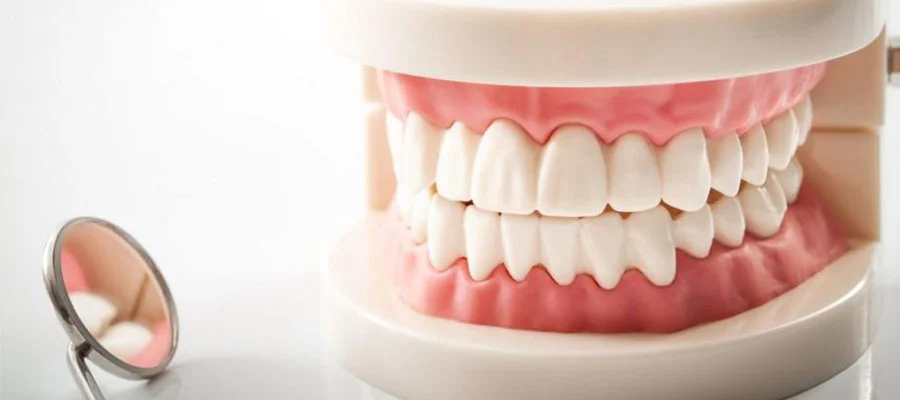
A dental prosthesis is an artificial tooth solution made to support chewing, speaking, and appearance by replacing missing teeth. It can be planned for different needs, from a single missing tooth to complete tooth loss. Over time, missing teeth can disrupt chewing balance, affect speech, and change facial support. Prosthetic treatment aims to reduce these daily-life effects and provide more comfortable use.
The treatment process starts with an examination. The gums and oral tissues are evaluated, and fixed or removable prosthesis options are planned based on the number of missing teeth. In some cases, retention can be improved with implant-supported prostheses. With correct planning, regular care, and follow-ups, dental prostheses can be used comfortably for a long time.
What Is a Dental Prosthesis?
A dental prosthesis is an artificial tooth structure placed to replace teeth lost for various reasons, restoring both aesthetics and function. Missing teeth can cause serious problems, not only in appearance, but also in chewing and speaking. This is where prosthetic dentistry becomes important. With advanced dental techniques, it is now possible to offer comfortable, long-lasting prosthesis solutions that look very close to natural teeth.
We plan the most suitable prosthesis treatments to help you regain missing teeth both aesthetically and functionally. You can get pricing from us and schedule an appointment for detailed information.
How Is a Dental Prosthesis Made?
Dental prosthesis treatment is planned according to the patient’s oral structure, the number of missing teeth, and the chosen prosthesis type. After the first examination and measurements, the prosthesis plan is created. If tooth preparation is needed, it is performed. Then impressions are taken and sent to the laboratory, where custom prostheses are produced. After try-in steps are completed, the prosthesis is fixed in place or delivered for use. Throughout the process, aesthetic appearance and chewing function are kept as priorities.
In prosthesis applications, we care about both your comfort and your smile aesthetics, and we plan the process together with you. You can take a confident step by getting pricing from us.
Who Is a Dental Prosthesis Suitable For?
A dental prosthesis is planned for people who struggle with chewing, speaking, or aesthetics due to missing teeth. For a single missing tooth, fixed prosthesis options may be considered. For multiple missing teeth or complete tooth loss, removable or implant-supported prostheses can be preferred. If tooth loss continues for a long time, chewing balance can worsen, teeth can shift, and changes in facial support can appear. A prosthesis helps reduce these effects and supports more comfortable daily use.
In suitability evaluation, gum health, the condition of oral tissues, and daily care habits are important. In some patients, implant-supported plans may be considered for stronger retention. The most accurate option becomes clear after examination and measurements.
➤People with a single missing tooth
➤People with multiple missing teeth
➤Completely toothless patients
➤Those who struggle with hard foods due to reduced chewing strength
➤Those who have difficulty with speech clarity
➤Those who have aesthetic concerns due to missing teeth
➤Those who have retention problems with removable dentures (for implant-supported options)
➤People whose oral tissues are suitable for a prosthesis and who can maintain regular care
How Long Do Dental Prostheses Last?
The lifespan of dental prostheses varies depending on the material used, how they are used, and personal oral care habits. In general, fixed prostheses can be used for about 10 to 15 years, while removable prostheses can be used for about 5 to 10 years in a healthy way. With regular dental check-ups and good oral hygiene, this period can be extended. If wear, color change, or loosening is noticed, renewal may be needed.
We work carefully to provide long-lasting and high-quality prosthesis applications and help you protect your oral health. You can get pricing from us and learn more details about expected lifespan.
What Are the Types of Dental Prostheses?
Dental prostheses are generally grouped into two main categories: fixed and removable. Fixed prostheses stay in the mouth and cannot be removed by the patient. Removable prostheses can be taken out and reinserted for daily cleaning. Implant-supported options are also frequently preferred to increase retention. The right choice depends on the number of missing teeth, gum and bone condition, comfort expectations, and care habits.
Fixed prostheses
➤Single crown
➤Bridge
➤Implant-supported fixed prostheses (single tooth, bridge, full-arch fixed)
Removable prostheses
➤Complete denture (for complete tooth loss)
➤Partial denture (for partial tooth loss)
➤Precision attachment denture
Implant-supported removable prostheses
➤Locator (snap) retained denture
➤Bar-retained denture
Hybrid solutions
➤Full-arch hybrid fixed prosthesis (framework plus upper structure combinations)
Advantages and Disadvantages of Using a Dental Prosthesis
A dental prosthesis can help reduce chewing and speaking problems caused by missing teeth and improve the appearance of the smile. With correct planning, it can support facial structure and increase daily comfort. An adjustment period may be needed at the beginning. Care needs differ by type, and regular cleaning and follow-ups are more critical for removable prostheses.
Advantages
➤Supports chewing function and makes eating easier
➤May help improve speech clarity
➤Improves smile appearance and can reduce aesthetic concerns
➤May help protect facial support
➤Reduces the feeling of a “gap” caused by missing teeth
➤Retention can increase significantly with implant-supported options
Disadvantages
➤In the first days, sore spots, pressure feeling, and an adjustment period can occur
➤In removable dentures, shifting and movement may occur (varies by person)
➤If care is not regular, odor and gum problems can develop
➤As the mouth changes over time, relining or adjustments may be needed
➤Extra care may be needed with very hard or sticky foods
What to Consider Before and After a Dental Prosthesis
Before a prosthesis, the goal is to have healthy oral tissues. If there are cavities, gum inflammation, or a need for extraction, these steps are completed first. The impression and try-in stage is important for proper fit and aesthetic harmony. After the prosthesis is delivered, follow-up visits are critical for adjusting sore areas and building correct usage habits.
Before
➤Gums and oral tissues should be checked
➤If there are cavities, inflammation, or extraction needs, treat them first
➤Do not skip impression and try-in appointments
➤Clarify expectations (fixed or removable)
After
➤Start with soft foods in the first days, reduce hard and sticky foods
➤If there is soreness, wounds, pain, or clear difficulty speaking, plan a check-up
➤If it is removable, remove and clean it daily and store it in its case
➤Follow the recommended routine for night use (often advised for removable dentures)
➤Do not neglect brushing and oral hygiene
➤Do not delay follow-up visits, prosthesis fit can change over time
How to Clean a Dental Prosthesis
Cleaning a dental prosthesis is one of the most important steps to protect oral health. For fixed prostheses, daily toothbrushing routines are usually sufficient. For removable prostheses, a denture brush and special cleaning solutions should be used. Prostheses should never be washed with boiling water and should not be worn down with hard brushes. Removable dentures should be taken out and cleaned after meals, and kept in a clean case during the night.
We share hygiene guidance with you and help you build correct cleaning habits. You can get pricing from us and learn our care recommendations.
How Long Does It Take to Get Used to a Dental Prosthesis?
Adapting to a new dental prosthesis usually takes from a few days to a few weeks. In the first days, there may be mild difficulty in chewing, speaking, and swallowing. This period can be a bit longer for people using removable dentures. As the mouth adapts, comfort and ease of use improve. Being patient and following the recommended steps makes adaptation easier.
We continue supporting you after treatment and guide your adaptation step by step. For detailed information and pricing, you can contact us.
What to Know Before Getting a Dental Prosthesis
Before starting prosthesis treatment, the mouth structure and general health should be evaluated. If there are gum problems or insufficient jawbone, these issues may need to be addressed first. Also, which prosthesis type is most suitable should be discussed together with long-term needs and aesthetic expectations. A well-informed process directly affects treatment success.
We provide personal evaluations before treatment and help you make a clear decision. You can get pricing from us and start the process with comprehensive consultation.
Dental Prosthesis Prices 2026
As of 2026, dental prosthesis prices may vary depending on the prosthesis type (fixed or removable), the materials used, the number of teeth, and the level of clinical complexity. Fixed prostheses are often more costly, while removable dentures can be a more budget-friendly option. Additional procedures (such as supportive steps or extra reinforcements) can also affect pricing. Prosthesis solutions that offer long-lasting and aesthetic results can provide strong long-term value.
We offer personalized pricing and payment options to match your budget. To get detailed information about 2026 dental prosthesis prices, you can contact us.
Frequently Asked Questions
How long does it take to make a dental prosthesis?
The time depends on the prosthesis type and your oral structure. For fixed prostheses, results are often achieved in about 1 to 2 weeks, including preparation, impressions, try-ins, and placement. For removable prostheses, it may be slightly shorter, but it is still usually completed in several visits. If additional procedures are needed (such as extraction or gum treatment), the total timeline may be longer.
You can get pricing from us and learn the most accurate timeline based on your personal plan.
Is eating comfortable with a dental prosthesis?
After the adaptation period, most people feel much more comfortable while eating. Fixed prostheses can provide a chewing feel close to natural teeth. With removable dentures, there may be a short adjustment period at the beginning. Once adaptation is complete, many foods can be eaten more easily. In the first days, avoiding very hard and sticky foods helps protect the prosthesis.
How long is the lifespan of dental prostheses?
Lifespan varies based on materials and care. Fixed prostheses often last around 10 to 15 years, while removable dentures often last around 5 to 10 years. Regular dental check-ups, correct cleaning habits, and proper storage can significantly extend this period.
Do dental prostheses cause speech difficulty?
In new users, speech patterns can change temporarily. Some sounds may feel difficult in the first days. This is usually temporary and improves as the tongue and palate adapt to the prosthesis. With fixed prostheses, adaptation is often faster. With removable dentures, it may take a few weeks.
Which is better, fixed or removable dentures?
There is no single best option for everyone. Fixed prostheses offer a more natural feel and look, and they do not shift during use. Removable dentures can be more economical and can be prepared faster, but some people may need longer adaptation. The right choice is made based on oral condition, comfort expectations, and care routine.
Do dental prostheses cause pain?
Prosthesis treatment is generally not a painful process. Local anesthesia can be used when needed. In the first days, mild sensitivity, sore spots, or pressure may occur, which is normal. Small adjustments may be needed during the adaptation period, and comfort usually improves quickly after these corrections.
What should be done if the prosthesis does not fit well?
If a prosthesis does not fit well, it can cause speech issues, difficulty while eating, or oral sores. These problems can usually be solved with simple adjustments. You should visit your dentist for relining, adjustment, or renewal if needed. Regular follow-ups are important, especially for removable dentures, because mouth shape can change over time.