


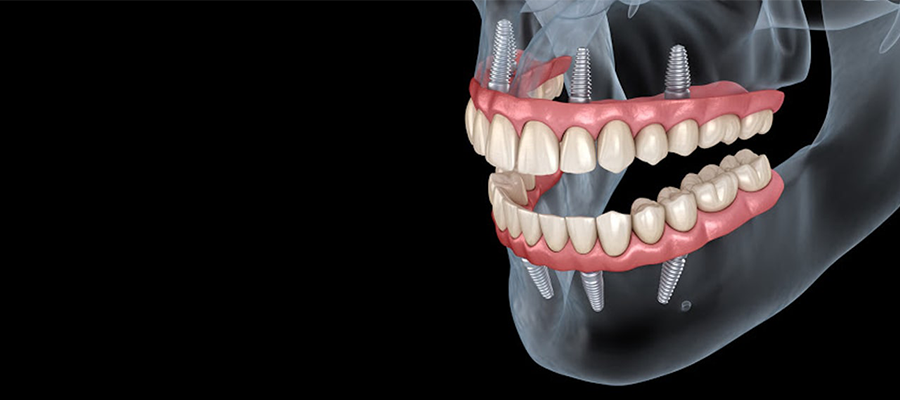
All-on-4 is an implant-supported treatment method designed to help people with complete tooth loss or multiple missing teeth transition to fixed teeth. In this method, four implants are usually placed in the same jaw, and a fixed prosthesis is planned on top of these implants. The goal is to reduce movement, sore spots, and retention problems seen with removable dentures, and to provide a stronger chewing feel. Especially in some cases with limited bone volume, placing the implants at an angle can aim for more stable support.
The treatment process starts with an examination and imaging. The jawbone, gum health, and bite are evaluated, and then the implant positions are planned. In suitable cases, a temporary fixed set of teeth can be provided on the same day, and after healing is completed, the permanent fixed teeth are placed. With regular oral care and follow-up visits, All-on-4 results can be maintained for a long time.
What Is All-on-Four Treatment?
All-on-Four treatment is a modern implant method developed to place fixed dentures on toothless jaws for individuals who want to regain oral function. Compared to traditional implant plans, this technique can provide faster results and may be considered even in people with limited jawbone volume.
A fixed prosthesis is placed on four implants positioned at strategic angles, offering both an aesthetic and functional solution. With this method, patients may receive temporary teeth on the same day, and their daily comfort can improve noticeably.
How Is All-on-Four Treatment Done?
Before the procedure, a detailed oral examination and jaw tomography are used to evaluate the bone structure. After the planning stage, four implants are placed carefully into the jawbone, typically two in the front and two in the back. The implants in the back area are placed at a specific angle to use the available bone more efficiently.
After the implants are placed, a temporary fixed prosthesis can be fitted on the same day, allowing the patient to return to daily life more quickly. After about 3 to 4 months, once the implants have fully adapted to the bone, the permanent prosthesis is placed and the treatment is completed. Patient comfort and aesthetics are kept in focus throughout the process.
Who Is All-on-Four Suitable For?
All-on-4 is a method used to plan fixed teeth for people who have complete tooth loss or teeth that are too problematic and require extraction. It aims to increase comfort for those who experience movement, sore spots, and retention problems with removable dentures. In some cases with limited bone volume in the upper or lower jaw, angled implant placement can help plan stronger support. Suitability must be confirmed through examination and imaging.
This treatment is often preferred by people who want faster recovery, more comfortable chewing, and the feeling of fixed teeth. Advanced age alone is not a barrier; the key factors are general health and oral conditions. It may also be considered as an alternative in situations where a bone graft plan would otherwise be needed.
➤People who have been toothless for a long time
➤Those who struggle with removable dentures
➤Those with retention problems and sore spots from dentures
➤People who need multiple teeth extracted
➤Some cases where a classic plan is difficult due to limited bone volume
➤Those aiming for fixed teeth in a shorter time
➤People who can follow regular care and check-ups
Differences Between All-on-Four and Other Implant Methods
In traditional implant plans, more implants may be required depending on the number of missing teeth and the planned prosthesis. In the All-on-4 approach, a fixed prosthesis foundation is usually planned with four implants in one jaw. This can simplify the surgical phase and may allow a faster treatment plan for some patients. Especially in cases with low bone in the back area, angled implant placement can widen the support zone.
Another key difference is that, in suitable cases, a same-day temporary fixed teeth plan can be possible. This aims for a faster transition in aesthetics and function without staying toothless for a long period. Still, “same-day teeth” may not be suitable for every patient; initial stability and bone condition are decisive.
➤A fixed prosthesis foundation is usually planned with 4 implants per jaw
➤In some cases, surgery and planning may be shorter and faster
➤Angled implant placement can be an advantage when back-area bone is limited
➤Temporary fixed teeth can be planned the same day for suitable patients
➤In some plans, the need for bone grafting may be reduced (not in every case)
➤With fewer implants, the cost plan may differ
Implant Types Used in All-on-Four
All-on-4 treatment typically uses titanium implants. Titanium is commonly preferred in implant dentistry because it has strong compatibility with bone. The implant diameter, length, and surface type are selected based on bone density, the placement area, and how chewing forces will be distributed through the prosthesis. For angled implants in the back region, suitable connectors (abutments) are used to ensure prosthesis fit.
When choosing an implant system, the goal is strong retention and long-term stability. Modern imaging and planning help position implants in a way that matches the prosthesis design, which is an important factor for success. In the permanent prosthesis stage, the material choice (such as zirconia or hybrid options) is also determined based on oral conditions.
➤Titanium implants (high bone compatibility)
➤Implant plans suitable for angled placement in the back region
➤Connection parts (abutments) for angled placement
➤Different diameter and length options based on bone density
➤Implant layout and system selection planned to balance prosthetic load
Advantages and Disadvantages of All-on-Four
All-on-4 is an implant plan that aims for a faster transition to fixed teeth in complete tooth loss. In suitable cases, using a limited number of implants can make the surgical phase easier to manage, and returning to daily life with temporary fixed teeth may be possible in a shorter time. Success is directly linked to correct planning, implant stability, and consistent care. Same-day teeth or a graft-free plan may not be possible for every patient.
Advantages
➤In suitable cases, the chance to transition to fixed teeth faster
➤A fixed prosthesis plan with fewer implants for a full arch
➤Better retention and comfort compared to removable dentures
➤More stable use for chewing and speaking
➤A chance for faster aesthetic recovery (in suitable cases)
➤May reduce the need for bone grafting in some patients
Disadvantages
➤Not suitable for every patient; case selection is critical
➤“Same-day teeth” may not be possible in every case
➤In the first months, a soft-food period and careful use are needed
➤If care is weak, the risk of problems around implants increases
➤Technical issues such as screw loosening or prosthesis fracture may occur
➤Risk may increase in people with teeth grinding or high chewing load
Treatment Process and Healing Period
The process starts with planning. During the first visit, the jawbone structure is evaluated in detail and suitability is analyzed. Before treatment, tomography and X-ray images are used to plan each step carefully.
The surgical placement of implants is usually performed under local anesthesia. Temporary fixed prostheses may be fitted on the same day, allowing a quicker return to daily routines. The healing period varies by person, but on average, the implants fully integrate with the jawbone within about 3 to 4 months.
During this time, keeping good oral hygiene, avoiding hard foods, and not missing recommended check-ups support smoother healing. If needed, supportive treatments can be used to make the process more comfortable.
What to Consider Before and After All-on-Four
Before All-on-4, the aim is to plan correctly and prepare the mouth for treatment. The jawbone, sinus areas, gum health, and bite must be evaluated. If extractions are needed, the plan is adjusted accordingly. For a smoother process, medications, systemic conditions, and smoking habits should be included in the treatment plan.
After treatment, protecting the healing period is very important. In the early phase, soft nutrition and good hygiene support bone integration. If temporary fixed teeth are used, hard foods and habits that create excessive force can increase risk. Regular check-ups and cleaning make it easier to move to the permanent prosthesis stage without issues.
What to consider before
➤Evaluation of bone and sinus areas with examination and imaging
➤Treating gum problems and infections first, if present
➤Clarifying which teeth require extraction within the plan
➤Reviewing medications and systemic conditions
➤Sharing smoking and teeth grinding habits
➤Clarifying temporary and permanent prosthesis steps in the plan
What to consider after
➤Choosing liquids and soft foods in the first days
➤Avoiding hard, crusty, and sticky foods in the first weeks
➤Not neglecting oral hygiene and using recommended cleaning products
➤Planning a check-up if swelling, bleeding, bad taste or smell, or increasing pain occurs
➤Following night guard advice if there is teeth grinding
➤Not missing follow-up appointments and having prosthesis adjustments regularly
➤Continuing interdental cleaning and professional cleaning routines after the permanent prosthesis
All-on-Four Treatment Prices 2026
Treatment cost varies depending on the implant brand used, how many jaws will be treated (upper, lower, or both), and individual needs. For this reason, instead of giving a fixed price, a personalized plan is created.
With a transparent pricing approach, the goal is to present the most suitable options based on expectations and budget. To learn your treatment plan, compare options, and get detailed information, you can contact us for a price quote. A personal evaluation is provided.
Frequently Asked Questions
Is All-on-Four a permanent solution?
All-on-4 aims for long-term use with correct planning and regular care. Once implants integrate with the bone, the fixed prosthesis can be used for many years. Still, long-term stability depends closely on oral hygiene, follow-up visits, habits like teeth grinding, and general health. If care is neglected, problems can develop in the tissues around the implants.
Is it possible to get teeth on the same day?
In suitable cases, a temporary fixed set of teeth can be placed on the same day. The key factor is whether the implants achieve enough stability at placement. Bone density, implant positioning, and additional procedures affect this decision. In some cases, for safer progress, temporary teeth may be placed at a different time.
Is the treatment painful?
Because local anesthesia is used, significant pain is not usually felt during the procedure. After treatment, swelling, sensitivity, and aching can occur in the first days. These complaints are usually controlled with medication and decrease day by day. If severe pain, increasing swelling, or prolonged bleeding occurs, a check-up is needed.
Can it be done if the jawbone is insufficient?
In some cases with limited bone, an All-on-4 plan may still be considered. Angled implant placement aims to use available bone more effectively in certain regions. However, not all bone deficiency is the same. If needed, additional procedures or different implant options may be planned. The most accurate decision is made after imaging and measurements.
How many days does All-on-Four take?
The surgical procedure is usually completed within the same day. However, the overall process does not end in one day. In suitable cases, temporary fixed teeth can be placed the same day and daily life can resume more quickly. For the permanent prosthesis, the healing and bone integration period needs to be completed. For this reason, the total timeline varies based on the planned prosthesis stages.
Are the prostheses fixed?
The goal in All-on-4 is a fixed prosthesis. The patient does not remove it for daily use. When needed, it can be removed in a clinical setting for maintenance and checks. This offers more stable use compared to removable dentures.
Is eating comfortable with All-on-Four?
After healing is complete, chewing comfort can increase significantly. In the first weeks, soft foods are recommended and hard foods should be avoided. During the temporary prosthesis phase, very hard foods can create risk. After the permanent prosthesis is placed, correct bite adjustment and good care can make daily eating more comfortable.
Can upper and lower jaws be done at the same time?
In suitable patients, upper and lower jaws can be planned at the same time. This decision is evaluated together with general health, bone structure, treatment duration, and comfort goals. In some cases, a staged approach may be more appropriate. The plan becomes clear after examination and imaging.
How should care be after treatment?
Post-treatment care directly affects how long All-on-4 results last. In the early period, prescribed medications should be used regularly and oral hygiene should not be neglected. Using suitable brushes and interdental cleaning tools for under-prosthesis cleaning is important. During regular visits, prosthesis screws, bite balance, and the tissues around implants are evaluated. Professional cleaning appointments should not be skipped.
Is All-on-Four suitable for everyone?
It may not be suitable for every patient. Risks can increase in people with active infection, uncontrolled systemic conditions, heavy smoking, very weak oral care, or poor treatment compliance. Bone structure may also require a different plan in some cases. Suitability is confirmed after examination and imaging.